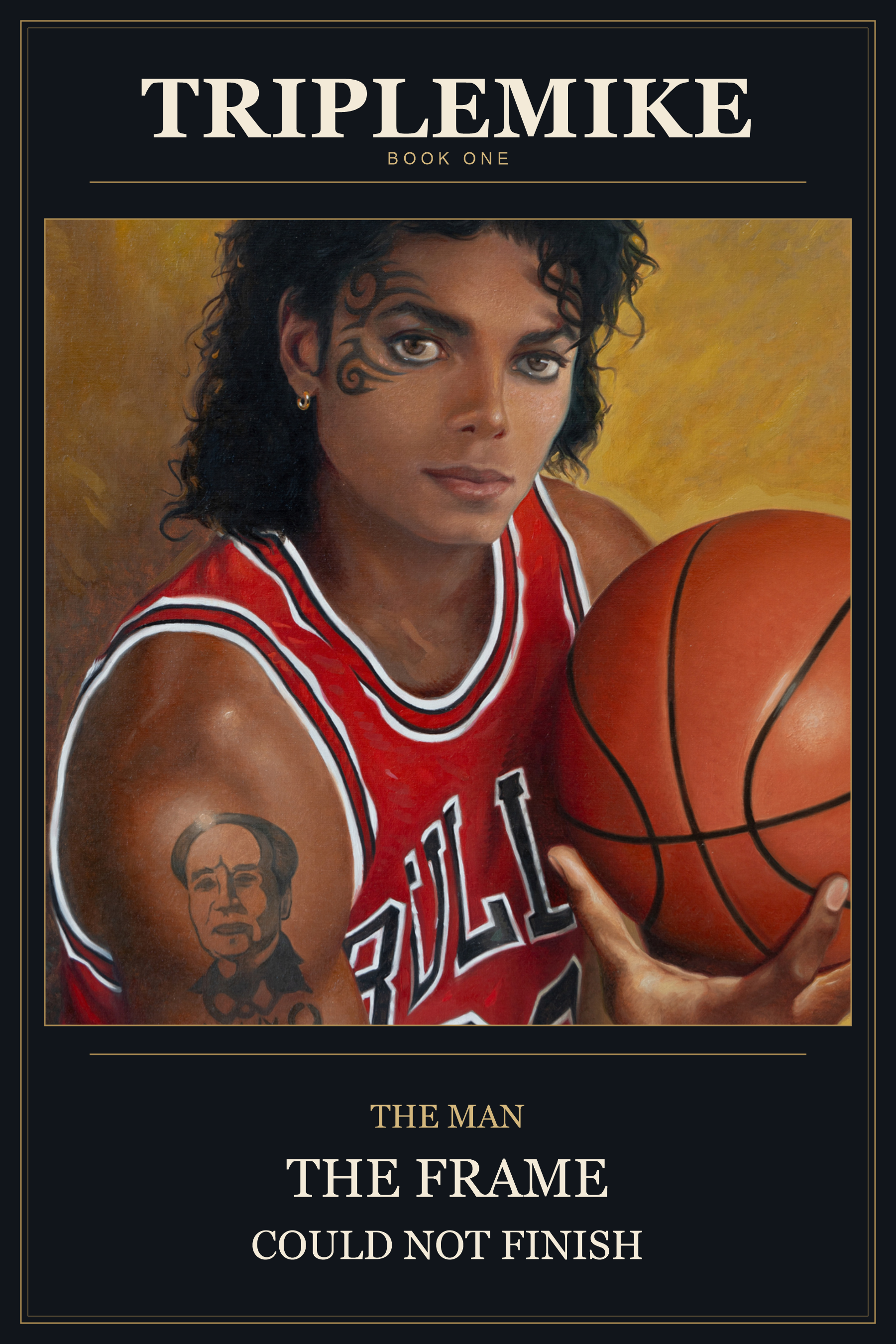
TRIPLEMIKE
Book One — The Man the Frame Could Not Finish
An expandable fiction grounded in the lives of Michael Jackson, Michael Jordan, and Mike Tyson.
Before the first bell
TripleMike is an invented person. He is neither a secret fourth Michael nor a claim that three real men lived one shared life. His adventures happen in the Afterimage, a fictional country assembled from the ways people remember public figures. Each chapter includes a Legacy Ledger: the real event, its source, and the precise transformation used in the story. The ledgers are outside the fiction. Dialogue, motives, monsters, magic, and encounters in the narrative are invented unless a ledger explicitly says otherwise.
Historical time and adventure time run differently. A room associated with 1982 can open onto one associated with 1997. This is an archive being crossed, not a rewritten historical chronology. Measurements are never presented as documented athletic records without evidence. The story does not assign Jordan a convenient but unverified vertical leap or turn a boxing result into a punch-force measurement.
For this project's artistic canon, Jackson Reed is the US artist who painted the TripleMike oil portrait, as supplied by the project creator. The painter's conversations and supernatural role below are fictional. No date, dimensions, commission history, or public provenance for that painting are asserted here. The tattoo's original creator is not established by the research available for this edition.
The story contains the uncomfortable parts of the legacies as well as their achievements. It preserves the difference between a proven conviction, a civil settlement, an allegation, an acquittal, and a rumor. It gives no fantasy court the power to reverse a real judgment.
Prologue — A Very Expensive Way to Make a Joke
The first person to notice the portrait was moving was trying to photograph it for a group chat.
He had already typed: bro got the deluxe Mike package.
On his screen the face looked wrong in exactly the right way. A recognizable fragment here, another there. The confidence of a man who had never needed a second introduction. Something in the eyes suggested that a beat, a bell, and a buzzer were all about to sound at once.
Then the portrait looked past the camera.
The visitor lowered his phone.
Behind the painted man, a background that should have stayed background acquired depth. There was a corridor inside it. At its far end stood a door without a handle, shuddering under the weight of people trying to get through.
The painted mouth opened.
“Don't crop the bottom.”
The visitor checked the photograph. He had cropped the bottom.
He took another.
At the lower edge, beneath the invented corridor, were tiny strokes he had mistaken for texture. Names. Hundreds of them. Musicians, coaches, opponents, brothers, technicians, witnesses. Not all belonged to people who had loved the three Mikes. Some belonged to people whose lives had been hurt by them. A few were too small for his camera to resolve.
The visitor swallowed. “Is this an installation?”
“Eventually,” said the man in the paint.
Outside the canvas a light flickered. Inside it, something large began climbing the corridor walls.
The visitor did what people do when the universe offers them an impossible responsibility.
He checked whether his phone was still recording.
Chapter One — The Country Behind the Screenshot
TripleMike woke with one hand wrapped and the other open.
His shoes disagreed with each other. The left wanted to slide. The right wanted to launch. When he stood, both feet argued that the floor was merely a suggestion.
He was lying in a square where three streets met. One smelled of hot wires and rehearsal sweat. Another carried the clean squeak of rubber on wood. The third tasted of leather, old fear, and a bell that had been struck too often.
Above the square hung an enormous picture of him.
It was not the oil painting. It was an image of ink on skin, stretched across the sky like a badly projected advertisement. Wherever the surface curved, the buildings below curved with it. The face was a collision of identities: instantly legible, impossible to place.
“Am I injured?” he asked.
“You're compressed.”
A woman sat on the edge of a dry fountain. Her coat had pockets full of index cards. She carried a ledger large enough to need its own weather.
“Nell,” she said. “Archive maintenance. You're late.”
“For what?”
“Existing properly.”
The square shook. Across the street, a shop window changed from a family photograph to a trophy. Then another changed. Faces disappeared from the photographs before the photographs vanished entirely.
Nell stood.
“That's the Curator. He makes things easier to remember.”
At the end of the avenue, a figure in a beautiful white suit raised a pair of scissors. He had no face, only a polished surface reflecting whatever the viewer most wanted to see.
“Ladies and gentlemen,” he announced, “we are pleased to offer a cleaner history.”
The sky-image tightened around TripleMike's head. He felt the pressure of a caption trying to become a biography.
Nell grabbed his wrist and ran.
Behind them, the fountain lost the names carved around its rim.
TripleMike looked back once. The Curator waved as if this were a product demonstration.
“Come quietly,” the white figure called. “I can make you iconic by lunch.”
Legacy Ledger — The image before the mythology
Historical anchor M01. A surviving Reddit post from August 2019 contains discussion recognizing the Jackson/Jordan/Tyson mashup and the name “triple mike.” It establishes circulation by that period, not original authorship. Later tattoo coverage describes the same composite. 2019 discussion, Inked tattoo overview.
Fictional transformation. An image on skin becomes the sky of an unstable country. Nell and the Curator are wholly invented. The Curator represents reduction of complex lives into marketable images; he is not a disguised real individual. This edition does not adopt the later article's suggested lyric-to-tattoo origin as proven genealogy.
Chapter Two — The House With Five Windows
The first safe house had five windows and no quiet room.
Through each window came a different part of the same rhythm. TripleMike heard a bass line, a guitar, feet moving in formation, a voice catching its own breath. He could almost remember which child had stood where. Every time he tried, the memory slipped into someone else's hands.
Inside, five chairs faced a rehearsal floor. The smallest chair was polished by use. On the wall hung a schedule with no entry for play.
“This is where your first road begins,” Nell said.
Something knocked beneath the floorboards.
TripleMike crouched. A small creature was trapped there: all elbows, knees, and oversized shoes. It looked like childhood drawn by someone who had only seen childhood from backstage.
“Get me out,” it whispered.
He pulled at the boards. They would not move. His wrapped hand hit the wood hard enough to hurt. The creature flinched.
“You're making it worse.”
He stopped.
The rehearsal room was filling with metronomes. They emerged from the cupboards, unfolded legs, and began ticking louder. Each demanded perfection at a slightly different speed. TripleMike tried to satisfy them all. His body found the beat immediately; his mind became smaller with every correction.
Nell put her ledger on the smallest chair.
“Who else is in the room?”
He looked at the other chairs.
The memory changed. The voice was extraordinary, but the music had not come from an extraordinary voice alone. There were brothers. There were musicians and writers beyond the house. There were people who had taught, arranged, accompanied, listened.
TripleMike stepped sideways and left space in the rhythm.
One metronome fell silent. Then another.
He reached under the floor through the gap between beats and lifted the creature free.
It did not turn into a trophy. It sat on his knee and refused to perform.
For the first time since waking, he understood how that could be a victory.
On the way out he took the schedule down. He could not give the real child a different past. But he could keep the missing hours from being mistaken for hours that had never mattered.
Legacy Ledger — A child inside the performance
Historical anchors J01–J03. Jackson was born in Gary, Indiana, on August 29, 1958. His early career developed with the Jackson 5; Motown identifies James Brown and Jackie Wilson among his influences. The group's early hits include “I Want You Back,” “ABC,” “The Love You Save,” and “I'll Be There.” Motown artist history, career overview.
Historical anchor J04. In his 1993 Oprah interview, Jackson described childhood beatings and lost childhood. Those are attributed personal accounts. Contemporary interview report.
Fictional transformation. Five chairs preserve the group context. The trapped creature embodies missing childhood; the metronomes embody relentless rehearsal. No fictional abuse scene is presented as a reconstruction of a specific real incident.
Chapter Three — The Door That Said Not Yet
The next road ended at a gymnasium door.
Above it, in letters designed to be read from a distance, someone had written: NOT ENOUGH.
TripleMike ran at it.
The door stayed shut. His shoulder did not.
He tried a harder run. Then a better angle. He wondered whether there was a trick in the hinges, a villain behind it, a secret weakness he could exploit.
There was another entrance to his left.
It was smaller. Its sign read PRACTICE.
“That's humiliating,” he said.
“Only if you need every room to be the final room,” Nell answered.
Inside was a court without a crowd. The ball came back whenever he missed. It came back whenever he made a shot, too. Apparently the room did not consider one good attempt sufficient evidence of anything.
He trained until the silence began to change shape. What had first sounded like rejection became instruction. What had felt like a permanent judgment became a description of a particular day.
Along the far wall stood shadows of people taller than he was. He attacked them with furious leaps. They did not move. He learned to change direction before leaving the floor. Then to plant. Then to see the space that existed before the spectacular part began.
After a time the smaller door opened onto another court, this one larger than the first.
TripleMike turned to Nell. “Did I beat the door?”
“No. You stopped treating the door as a prophecy.”
Behind him, the letters above the original entrance rearranged themselves.
NOT YET.
At the next junction a dealer offered him a bottle marked FORTY-EIGHT INCHES — GUARANTEED GREATNESS.
Nell tipped the bottle over. Nothing came out.
“What was in it?” TripleMike asked.
“A number people like repeating.”
He left the bottle in the gutter and continued on foot.
Legacy Ledger — Rejection without the shortcut
Historical anchor R01. Jordan did not make Laney's varsity roster as a sophomore; that is not the same as being excluded from all basketball. The career account places his development at Laney before UNC. Jordan biography.
Fictional transformation. The practice entrance rejects the familiar oversimplification that one roster decision meant total exclusion. The empty bottle rejects unverified physical measurements. No exact jump height is required for the character's growth.
Chapter Four — Fear Lives Upstairs
The third road smelled of rain on a Brooklyn roof.
Pigeons moved along the ledge above a locked stairwell. Below them, the alley had been converted into a museum of bad decisions. Every display case contained a younger version of someone insisting he knew what he was doing.
TripleMike recognized none of their faces. He recognized the feeling.
A door opened in the wall and a boy in oversized gloves beckoned him inside. The corridor led through an institution, then a training room, then a house above a gym. The arrangement made no geographical sense. It made emotional sense immediately.
At the top of the stairs sat an old instructor with a lamp beside him.
“What frightens you?” the instructor asked.
“I haven't decided.”
“Then fear will decide for you.”
The lamp went out.
In the dark, the room filled with punches. TripleMike could hear them before he could see them. He swung at the noise and missed. Something struck his ribs. Another blow met his guard.
“Move your head,” said the instructor.
TripleMike bent his knees. His wrapped hands rose beside his face. He began to move between blows, learning the small distances that make a large force useless. He stopped reaching angrily across the room and started arriving close enough to do something precise.
When the light returned, there had been no opponent.
Only hanging weights, ropes, and the consequences of poor positioning.
“You have power,” the instructor said. “That's the part strangers notice.”
“And the other part?”
“The part you must do when nobody is impressed.”
TripleMike stayed. Outside, the pigeons returned to their ledge. Inside, instruction replaced the pleasure of being feared.
One morning the lamp was cold and the chair empty.
He waited for a voice from another room. None came.
Nell stood at the bottom of the stairs, holding a card she wished she did not have to deliver.
TripleMike understood that he would be able to carry the lessons farther than the teacher.
It did not make the empty chair smaller.
Legacy Ledger — Instruction and loss
Historical anchors T01–T04. Tyson was born in Brooklyn on June 30, 1966. At Tryon he encountered Bobby Stewart, who connected him with Cus D'Amato. Tyson turned professional against Hector Mercedes on March 6, 1985; D'Amato died on November 4 that year. New Jersey Boxing Hall of Fame history.
Fictional transformation. The unnamed instructor and impossible building condense that chain of mentorship. Defensive positioning accompanies the character's striking power. The narrative dialogue is original, not a quotation from D'Amato. Rooftop pigeons are a recurring fictional motif; they are not used to authenticate a particular childhood anecdote.
Chapter Five — Eighteen Seconds of Sky
The first major crossing lay inside a dome with a river beneath its floor.
On the opposite bank stood a tall gatekeeper carrying a shield. Above him, a clock was counting down. The bridge would exist only long enough for one attempt.
TripleMike ran toward the edge and felt all his instincts collide.
The wrapped hand wanted to break the gatekeeper. The open hand wanted to conduct him. His right foot wanted to jump straight over the problem and call that a strategy.
“Look left,” Nell shouted.
Across the bank, two companions were drawing the gatekeeper's attention. TripleMike had been so busy imagining himself as the climax that he had barely seen them.
One sent a small light across the water.
He caught it.
The clock showed eighteen seconds.
The bridge appeared under his plant foot. He rose, measured the open space rather than the defender's reputation, and released the light into a slot above the gate.
The river became a court. The slot became a ring. The gate opened before the light had finished falling.
He landed on the far side and grinned too broadly.
“I did it.”
The bridge began to collapse behind Nell.
TripleMike reached back. The companions reached too. Together they dragged her across as the last plank folded into the river.
On the opened gate, a score burned into the stone: 63–62.
He studied it for a long moment.
He had crossed by one small difference, inside a result made possible by many people.
The gatekeeper lowered his shield. He was not a defeated monster. He was a worthy opponent who would appear elsewhere in the archive.
“Remember my name when you tell this,” he said.
TripleMike promised.
Legacy Ledger — The freshman and the team
Historical anchor R02. Jordan's winning jumper in the 1982 NCAA final helped UNC defeat Georgetown 63–62. The NBA account places eighteen seconds on the clock. James Worthy and Sam Perkins were senior figures around the freshman; Patrick Ewing played for Georgetown. Basketball Hall of Fame, NBA historical profile.
Fictional transformation. The light is a shot, the bridge its opportunity, and the companions its team context. The gatekeeper acknowledges an opponent's importance. The river crossing is supernatural; its length is deliberately not equated to a documented human leap.
Chapter Six — The Street That Moved Backward
The next city had a street that moved forward faster than anyone could walk.
At the end stood a broadcast tower. Its doors opened only to an audience's attention, and the audience was looking somewhere else.
TripleMike tried sprinting. The pavement carried him back.
He tried leaping. He landed farther from the tower.
The Curator appeared on a billboard overhead.
“You need a miracle,” he said. “Something nobody has ever done before.”
At the corner, an old dancer was sweeping a small patch of stage. Another practiced a glide in the window of a television shop. Behind them stood figures from older performances, visible only when TripleMike stopped looking at himself.
He watched their feet.
Then he tried.
The first glide was terrible. The second was less terrible. By the third he understood that seeming effortlessness demanded effort placed where the observer could not easily see it.
He faced away from the tower and moved backward.
The street slowed.
Every window lit up. People who had been indifferent a moment earlier gathered at the glass. Their attention traveled toward him, along with the borrowed vocabulary of steps he had learned.
The tower doors opened.
The Curator's billboard went blank except for two words: HE INVENTED—
TripleMike tore the sentence down before it could finish.
“No,” he told the gathering crowd. “I learned.”
Inside the tower two clocks hung side by side. One kept the time of the room where a performance happened. The other kept the time when the performance reached the world.
“Which clock is right?” he asked.
“Both,” Nell said. “That's what an archive is for.”
A glove lay on a chair near the transmission equipment. He picked it up and put it in his pocket rather than on his hand.
He had learned something more useful than appearing miraculous.
Legacy Ledger — A performance and its transmission
Historical anchor J05. Motown 25 was taped in Pasadena on March 25, 1983, and broadcast on May 16. Jackson's “Billie Jean” performance popularized the moonwalk; he did not originate the entire dance tradition. Jeffrey Daniel is an important figure in its transmission to Jackson. Motown history, broadcast chronology, dance history.
Fictional transformation. The backward street turns a recognizable dance into an escape mechanism. The two clocks preserve the difference between taping and broadcast. The scene's teachers are invented composites, not an assertion that every predecessor met Jackson personally.
Chapter Seven — Nine Rooms and a Stranger's Voice
Beyond the tower was a building whose rooms refused to agree on what kind of building they belonged to.
One held a restless crowd. Another contained a conversation about desire. In a third, the lights went out and something dead remembered how to dance. A fourth smelled of amplifiers heating up. A fifth held a rhythm so economical that removing anything would have left a hole.
There were nine rooms in all.
The Curator had installed identical doors over them. Each read GENIUS ALONE.
TripleMike opened the first and found a workshop.
Someone was adjusting the sequence of the rooms. Someone else was writing. Engineers listened to details most visitors would never consciously notice. A guitarist from another musical world had left a scorched cable on a chair. An old actor's voice moved through the darkness with terrifying politeness.
The rooms were remarkable because they were different and because people had made those differences work together.
Then the dead began to climb out of the third room.
TripleMike retreated down the hall. He prepared to fight them, but their movements were coordinated. They were not attacking at random. Someone had arranged their entrance.
He followed the rhythm instead.
At the end of the phrase they stopped. When he broke the phrase, they lunged.
“Don't confuse frightening with uncontrolled,” Nell called.
TripleMike brought them through the corridor one group at a time, letting the next room answer the previous one. The building settled. The false doors split down the middle, revealing names the Curator had covered.
In the award room, eight lights lit up.
He almost reached for all eight at once.
Nell pointed to a small door beside the large ones. Its room contained a child's listening chair and a story from beyond Earth.
One of the lights belonged there.
“If you rush the count,” she said, “you tell the wrong story even when the total is right.”
TripleMike returned the light to its room.
The stranger's voice laughed gently in the dark.
Legacy Ledger — Construction behind the spectacle
Historical anchors J06–J09. Thriller has nine tracks; seven became US top-ten singles. Rod Temperton wrote the title song, previously called “Starlight,” as well as “Baby Be Mine” and “The Lady in My Life.” Quincy Jones's production and the work of collaborators are central to its history. Eddie Van Halen contributed to “Beat It”; Vincent Price supplied the spoken horror passage. Library of Congress essay, AP account of Quincy Jones's work.
Historical anchor J10. Jackson won eight Grammys in 1984; one was Best Recording for Children for the E.T. storybook recording. “Eight for the album” blurs that distinction. Recording Academy ceremony, E.T. award history.
Fictional transformation. The building's sequence becomes a way to control a horror encounter. The extra listening room prevents a numerically correct but categorically wrong account of the awards.
Chapter Eight — Fire Does Not Applaud
They reached the staircase while the crowd was still cheering.
TripleMike had begun to enjoy how the Afterimage greeted him. Doors opened. Strangers recognized him without needing to agree on whom they recognized. Everywhere there was a promise that the next entrance would be larger than the last.
On the staircase, sparks came from behind him.
He thought they were part of the show.
Then pain changed the meaning of the light.
His open hand flew to his head. Somewhere in the crowd a person kept applauding, a beat too late to understand. Nell pushed through them carrying a coat. Someone cut the transmission. Someone else called for help.
There was no enemy to defeat. There was a malfunction, and a body inside it.
The Curator appeared at the foot of the stairs holding two cards.
The first said TRAGEDY MAKES LEGENDS STRONGER.
The second said PAIN IS CONTENT.
TripleMike knocked both into the fire.
In the ward afterward, he stared at the ceiling. His wrapped hand could destroy a door, but it could not command damaged skin to stop hurting. His right foot could jump, but not out of his own body.
The child-creature from the first house sat beside his bed, saying nothing.
Days later, an administrator showed him a plan for an additional treatment room. The building could care for people whom the crowd had never heard of.
TripleMike signed the plan.
He did not emerge from the ward with a secret new ability. He emerged slower, carrying the knowledge that a performance can continue in people's memories while the performer is still paying for it.
At the door, someone asked whether the fire had improved his destiny.
“It burned me,” he said.
The answer was too plain for the Curator to sell.
Nell recorded it anyway.
Legacy Ledger — Injury and care
Historical anchor J11. On January 27, 1984, Jackson suffered scalp burns during filming of a Pepsi advertisement at the Shrine Auditorium. Contemporary reporting describes a pyrotechnic mishap. Later accounts record his $1.5 million settlement donation to Brotman Medical Center. UPI report, philanthropy chronology.
Fictional transformation. The staircase is an injury episode, not an origin for superpowers. The ward extension echoes philanthropy. This scene does not claim the accident explains every later health problem or the circumstances of Jackson's death.
Chapter Nine — Sixty Three and Still a Loss
The Garden was a fortress that enjoyed being old.
Its gates were green. The sentries had learned one another's movements so well that the walls seemed to defend themselves. TripleMike arrived with a recently repaired foot and the reckless joy of being allowed to move again.
He broke the first seal.
Then the next.
At each seal, an alarm announced his achievement. Spectators crowded onto the battlements. By the twentieth, even the defenders were watching with reluctant curiosity.
“He's doing it alone,” a spectator shouted.
TripleMike liked the sentence. That should have warned him.
The fortress lengthened. The first allotted time expired and another began. Then another. TripleMike kept attacking until sixty-three seals lay broken behind him.
The final gate stayed closed.
The defenders had scored elsewhere, in corridors he had ignored and through people he had failed to see. His spectacular route had not controlled the whole contest.
When the last bell sounded, the Garden remained theirs.
He sat on a step, furious enough to make his own achievement feel worthless.
Nell joined him.
“Can it be a great performance and a loss?” she asked.
“Apparently.”
“Then write both.”
A man from the battlements approached and left a green card on the step. On it was admiration so extravagant TripleMike almost mistook it for a victory.
The fortress doors stayed closed behind the admirer.
TripleMike folded the card carefully.
He could keep the praise. He could keep the defeat. Neither required the other to disappear.
As they left, the Curator offered to remove the result from the souvenir program.
For the first time TripleMike did not even slow down to answer.
Legacy Ledger — An achievement inside a defeat
Historical anchor R03. April 20, 1986: Jordan scored 63 playoff points against Boston; Chicago lost 135–131 in double overtime. Game box score.
Fictional transformation. Sixty-three broken seals preserve the scoring number without changing the outcome. The praise card alludes to Larry Bird's famous admiration without reproducing his quotation. Individual excellence is not rewritten as a team win. Note that some overview accounts misprint Boston's score; game-specific reporting is the preferred anchor.
Chapter Ten — The Crown That Came in Pieces
The Iron Road ended in a ring surrounded by three locked galleries.
At the first stood a large opponent whose balance was harder to steal than his attention. TripleMike moved inside his reach, struck, changed angle, struck again. The bell found the encounter already over in its second round.
A crown descended.
It had one point.
“That is a very disappointing crown,” TripleMike said.
“One title,” Nell answered. “There are others.”
In the second gallery, the opponent held on. Whenever TripleMike tried to create room for a perfect finish, the man smothered the space. The crowd grew impatient. The clock demanded rounds instead of moments.
TripleMike wanted to explode through the problem. Instead he learned to work inside it. When the decision came, a second point was attached to the crown.
The third gallery was longer still. Its guardian could absorb punishment, survive trouble, and make the early part of a contest uncomfortable. TripleMike stayed disciplined. He won without supplying the instantaneous ending the spectators wanted.
The crown gained its third point.
Beyond it stood a final hall, where a rival held a different claim to the same throne.
This time everything happened quickly.
TripleMike stepped across the floor. Two exchanges, a knockdown, another decisive attack. The hall's clock stopped at ninety-one seconds.
The crowd became a single sound.
When it quieted, he looked up at the crown again.
The first point had come earlier. The others had required patience. The last hall had settled another kind of dispute. All the distinctions were already disappearing from the songs people sang outside.
He wrote them in Nell's ledger before sleeping.
At dawn the Curator came to congratulate him.
“People prefer the version where you knock out everyone,” he said.
TripleMike touched the crown's patient middle points.
“People can learn.”
Legacy Ledger — Titles, decisions, and ninety one seconds
Historical anchors T05–T08. Tyson won the WBC title against Trevor Berbick in Las Vegas on November 22, 1986, aged twenty years and 145 days; the stoppage was at 2:35 of round two. In 1987, twelve-round decisions over James Smith and Tony Tucker added the WBA and IBF belts. On June 27, 1988, he knocked out Michael Spinks in Atlantic City at 1:31 of round one. Guinness record, Berbick fight record, title chronology, Spinks fight record.
Fictional transformation. The separate galleries preserve the distinction between winning one belt, unifying three sanctioning-body titles, and defeating Spinks, who held the lineal claim. The ninety-one-second clock is elapsed fight time, not an invented speed or force record. Smith and Tucker's decision losses remain important victories in their own right.
Chapter Eleven — Air Has a Floor
The next trial was held above a crowded city, on a court built along the edge of a roof.
A rival jumper stood across from TripleMike. He had his own following, his own violent grace, and no intention of becoming a supporting character in somebody else's legend.
They took turns making the impossible look close enough to touch.
The judges raised numbers. The crowd argued with the judges. The rival's supporters argued with the crowd. Nell noted that an archive contained disagreement even when the trophy contained only one name.
For his final attempt, TripleMike walked back toward a painted line.
“How far?” he asked.
Nell opened her measuring case.
“The geometry is knowable. Your precise distance in the air is another question.”
He looked at the line, the basket, the space between them.
The Curator whispered from a speaker: “Let us say you flew six meters. Nobody checks.”
TripleMike unplugged the speaker.
He ran, planted near the line, and rose. In the air his body seemed to discover an extra sentence before landing. His arm carried the ball toward the rim. His feet arrived on the floor sooner than he wanted and exactly when physics required.
The judges lifted a perfect score.
The city exploded around him.
He turned toward the rival, still breathing hard. For a moment the rival looked less like an obstacle than the reason the contest had become worth remembering.
TripleMike offered his hand.
The rival accepted, then jerked him close enough to speak privately.
“Don't let them erase my side.”
“I won't.”
As they left the roof, the Curator's discarded speaker continued to whisper numbers nobody had measured.
Nell put it in a box labeled ATTRACTIVE NONSENSE.
The box was already very full.
Legacy Ledger — A dunk and its boundaries
Historical anchor R04. In Chicago's 1988 dunk contest, Jordan defeated Dominique Wilkins; his celebrated free-throw-line dunk received a score of fifty. NBA contest history.
Fictional transformation. The rooftop contest preserves the rival and the score. “Near the line” avoids pretending a floor marking precisely measures takeoff. No flight length, hang time, or vertical leap is authenticated here. The story's brief impression of suspended time is literary description.
Chapter Twelve — Five Doors and a Mirror
The city beyond the court had five doors, each claiming to be the only entrance worth using.
TripleMike opened the first and heard tenderness.
The second demanded confrontation. The third swept him into a street where everybody had a different reason for dancing. The fourth held a mirror. The fifth opened onto a stage where attention felt dangerously close to appetite.
A king could have claimed the whole building. TripleMike had begun to dislike the word whole when strangers used it about him.
Behind the five doors were writers, duet partners, players, arrangers, film workers, and dancers. Their labor connected the entrances. If he removed their names, the rooms still looked impressive for a moment, but the floors became unreliable.
At the mirror door he stopped.
His reflection wore every trophy he had collected. The reflected man stood taller, brighter, cleaner. His bandages were missing. So were the people behind him.
“Very good,” said the reflection. “Now we can begin.”
TripleMike put his hand against the glass.
On the other side, the reflected hand had no scars.
“Begin what?”
“Your better biography.”
Nell grabbed him before he stepped through. Something in the mirror reached for his throat.
He slipped under its arm, turned, and shattered the glass with his wrapped fist. The pieces fell into a ring around him. Each piece reflected a different feature of his face.
One showed the performer. One the competitor. One the fighter.
All three looked frightened.
He gathered the pieces rather than sweeping them away.
They would become useful later, when he needed to know how a flattering image had acquired teeth.
Outside, every door bore a little crown. Nell checked the inscription beneath each.
“United States,” she said. “Always keep the map attached to the number.”
Legacy Ledger — Which chart, which collaborators
Historical anchor J12. Bad produced five Billboard Hot 100 number-one singles: “I Just Can't Stop Loving You,” “Bad,” “The Way You Make Me Feel,” “Man in the Mirror,” and “Dirty Diana.” This is a US chart claim; UK results differ. Billboard-derived album history, Official Charts' UK account.
Fictional transformation. The five doors are the five US number ones. The mirror introduces an original antagonist mechanism; it is not a literal interpretation of the song's plot. The story does not treat every Jackson recording as written by Jackson alone.
Chapter Thirteen — The Man Who Had His Own Mother
In Tokyo, TripleMike found a ring so large it seemed to include the whole horizon.
The Curator had already printed the ending.
Street vendors sold posters showing TripleMike victorious. The opponent's face appeared only as a dark space beneath his raised hand. Every poster used the word INEVITABLE.
TripleMike bought one.
“You should throw that away,” Nell said.
“Afterward.”
Across the ring stood a man whose eyes kept returning to an empty seat.
“Who sits there?” TripleMike asked.
“Someone who won't see this,” the man answered.
The bell sounded.
TripleMike expected fear. He met a jab.
He expected retreat. He met someone taking his ground seriously.
The early rounds turned awkward. Then painful. The crown dragged on his head. Each time he reached for the short ending promised by the poster, the opponent offered a longer problem.
In the eighth round TripleMike landed a blow that put the man down.
He walked away believing the world had corrected itself.
Behind him, the man rose.
By the tenth, TripleMike was the one on the floor.
His mouthguard lay nearby. He searched for it as if finding one missing object would restore the larger order. Above him the opponent looked exhausted, hurt, and fully present.
The count ended.
The crown broke into three ordinary pieces.
TripleMike did not get up in time. Nell did not produce a loophole. The Curator did not persuade the ring to accept the poster as evidence.
Later, in the empty arena, TripleMike tore the poster down the middle.
“I thought he was here to lose to me.”
“He was here to live his own life,” Nell said.
TripleMike looked at the empty seat again.
Only then did the loss acquire a shape larger than his humiliation.
Legacy Ledger — The opponent owns a story
Historical anchor T09. On February 11, 1990, Buster Douglas defeated Tyson in Tokyo by tenth-round knockout, after recovering from an eighth-round knockdown. Douglas's mother, Lula Pearl, had died twenty-three days before the fight. BoxRec bout record, World Boxing Council remembrance.
Fictional transformation. The printed ending represents presumed invincibility. The empty seat preserves Douglas's grief and independent story. Fantasy does not nullify the result through disputed count claims. Different summaries disagree on stoppage notation or timing; the bout record's KO at 1:23 is the reference adopted in the factual database.
Chapter Fourteen — The Wrong Number and the Right Name
Three days after the broken crown, TripleMike's jersey disappeared.
He searched his room, the hallway, the laundry, and one suspicious pigeon. Nell searched the ledger. Neither found it.
The equipment keeper offered him a replacement.
It had twelve on the front and no name on the back.
“That's not me,” TripleMike said.
“It's fabric,” Nell answered.
He wore it anyway.
At the next court he performed so fiercely that the spectators began chanting a number they had not expected to chant. The nameless jersey became famous before the contest was over.
His side lost.
TripleMike was getting tired of that part.
Some weeks later, on another road, the contest ran beyond its allotted time. He found a rhythm that did not abandon him when his lungs started burning. He kept scoring. He kept collecting what fell loose. He kept passing to people who could use the opportunity.
When the final count appeared, it read sixty-nine.
This time his side won.
“Better,” he said, collapsing beside Nell.
She pointed to the rest of the record. “There's more to the game than the largest number.”
He looked at the catches, the passes, the attempts required to create the result. The victory was impressive in ways the souvenir poster would not explain.
That night he dreamed of twelve and twenty-three arguing over who owned his face.
He woke before either won.
At breakfast Nell placed a card between them.
IDENTITY IS NOT AN EQUIPMENT INVENTORY.
He wrote a second sentence beneath it.
BUT KEEP THE EQUIPMENT INVENTORY. PEOPLE ASK.
Nell smiled. It was the first time he had improved a joke without damaging a fact.
Legacy Ledger — A rare jersey and a fuller box score
Historical anchor R05. Jordan wore a nameless number-twelve jersey and scored forty-nine against Orlando on Valentine's Day 1990, after his usual jersey was stolen. NBA video account, season record.
Historical anchor R06. March 28, 1990: Jordan scored sixty-nine in a 117–113 overtime win over Cleveland, adding eighteen rebounds and six assists; he shot 23-for-37. NBA anniversary footage and statistics, game summary.
Fictional transformation. The lost garment questions identity; the second contest separates a scoring achievement from a complete contribution. The “three days” follows the historical February 11/14 proximity of Tyson's loss and Jordan's jersey incident; it does not imply the two real events were causally connected.
Chapter Fifteen — The Warehouse Where the Hands Agreed
Nell took him to a warehouse with a basket at one end and a makeshift stage at the other.
“You need to learn something embarrassing,” she said.
TripleMike's open hand was excellent at rhythm. His right foot was excellent at launching him toward a goal. Neither respected the other's expertise.
He tried to dance with the foot that wanted to dunk. He looked like a man escaping an invisible puddle.
He tried to shoot with the hand that wanted to shape a phrase. The ball described an expressive failure.
The child-creature laughed so hard it fell off a crate.
TripleMike bowed to it. Then tried again.
Gradually the exchange became instruction. He stopped expecting excellence in one field to automatically become excellence in another. The dancer taught the competitor to glide; the competitor taught the dancer to square his body and trust the release.
His wrapped hand waited beside them.
“You too,” he told it.
He learned that the slipping movement from the gym could prepare a turn onstage. A planted foot could support a shot or a defensive angle. Timing could invite contact, avoid contact, or transform it into expression.
For the first time his body moved as a conversation.
Then the warehouse shutters slammed down.
The Curator's scissors cut through the wall, deleting the names from Nell's ledger one line at a time.
TripleMike caught the ledger before it hit the floor. He spun away from the scissors, planted, and passed it across the room. Nell received it behind a crate. He slid backward while facing the threat, slipped beneath the next cut, and sent a ball into the release above the shutters.
The room reopened to daylight.
The Curator stood outside, furious.
“You are supposed to be three recognizable things.”
TripleMike stepped into the sun.
“I'm learning to be a person.”
Legacy Ledger — A real crossing of two legacies
Historical anchor X01. The 1992 “Jam” video pairs Jackson and Jordan in a gym, with basketball and dance lessons exchanged. Contemporary Billboard video coverage, participant oral history.
Fictional transformation. The warehouse is a genuine Jackson/Jordan crossover anchor. Adding the wrapped hand creates TripleMike's imagined third contribution. Tyson's participation in the real “Jam” video is not asserted. The Curator attack and physical integration are original fiction.
Chapter Sixteen — The Room You Cannot Win
The courthouse door was smaller than the championship entrances.
TripleMike still expected a contest. That was the problem.
Inside, the walls carried testimony. Some lines were allegations. Some were adjudicated findings. Some were words spoken by famous men about themselves. Some were denials. Nell's job was to keep the labels attached while the room shook.
The Curator had been there first.
On one wall he had painted IT WAS ALL A MISUNDERSTANDING.
On another, IF YOU CAN'T PROVE EVERYTHING, NOTHING MATTERS.
Both slogans were eating the records beneath them.
TripleMike lifted his wrapped fist. “Tell me which wall.”
Nell caught his arm.
“You don't punch your way through this.”
At the center of the room stood a chair he was not permitted to occupy. It belonged to someone whose name the crowd kept treating as a footnote to somebody else's career.
There was no magical testimony. No hidden witness appeared to clear a legend. No monster wore an accuser's face. The room simply required him to read what it contained without replacing it with the version that made him feel better.
One record had a conviction attached. Another had an acquittal. A settlement remained a settlement. Allegations did not become convictions by being repeated. A verdict in one case did not turn every other statement into either truth or falsehood.
TripleMike stood still long enough for his hands to stop looking for a weapon.
The door opened.
Beyond it lay a corridor of consequences, not a reward chamber.
He could leave carrying the record. He could not leave carrying the promise that a new costume or a later achievement would cancel it.
As he passed the unoccupied chair, he kept its name visible.
Outside, the Curator waited with a joke prepared.
TripleMike did not let him tell it.
Legacy Ledger — The legal records retain their categories
Historical anchor T10. Tyson was convicted of raping Desiree Washington on February 10, 1992, received a six-year prison term, and served approximately three years. This is a criminal conviction, not merely a rumor or allegation. AP retrospective, contemporary UPI sentencing report.
Historical anchors J13–J14. Jackson faced child sexual abuse allegations in 1993; a civil case was settled in 1994 without an admission of liability. On June 13, 2005, a jury acquitted him on all charges in a separate criminal case. He denied abuse allegations. The acquittal is specific to that trial; the settlement is not a conviction. AP verdict reporting, trial chronology.
Fictional transformation. The records room stages the discipline of remembering responsibly. The narrative does not reenact sexual violence, identify accusers as fantasy villains, or equate Tyson's conviction with Jackson's acquittal. TripleMike's journey is not a factual admission by any real man. This distinction is part of the saga's permanent canon.
Chapter Seventeen — The Bus With No Throne
The road out of the archive passed an empty seat at an ordinary breakfast table.
TripleMike stopped so abruptly that Nell almost walked into him.
Nothing attacked. No mechanism demanded a code. A cup stood where a hand should have been.
He had survived monsters made of edited photographs. The cup was worse.
“Can we bring him back?”
Nell shook her head.
“Then why keep the room?”
“Because losing someone doesn't make the relationship disappear.”
He sat until the light changed.
When he rose, he left the crown fragments behind and took a wooden bat from the wall. The next door led to a bus crowded with people who were good at a game he was trying to learn.
At the first stop he missed.
At the second he missed differently.
The spectators were astonished to discover that the famous man could be bad at something. TripleMike was astonished to discover how many ways a moving ball could refuse a reputation.
He kept traveling.
Some days he reached base. Some days he stole enough ground to make a teammate laugh. Often he returned to the bench with nothing to show except another attempt he could now understand.
One passenger asked if the bus was a punishment.
The Curator, sitting in the aisle, immediately answered yes.
Nell opened a record proving no such thing. The Curator changed the subject.
At the last stop TripleMike's ledger contained numbers that looked unimpressive beside his old ones. They were still his numbers. He had earned them in a world that did not owe him mastery.
He wrote two words on a card, then placed it where the bus driver could see.
I'M BACK.
But the road home would not lead straight to a parade.
Legacy Ledger — Grief, baseball, and the unsupported conspiracy
Historical anchors R07–R09. Jordan retired in October 1993 after his father's murder that summer. In 1994 he played for the Double-A Birmingham Barons: 127 games, .202 average, three home runs, fifty-one RBIs, thirty steals, and 114 strikeouts. He announced his basketball return in March 1995. Jordan career chronology, Baseball-Reference statistics, Hall of Fame career account.
Historical anchor R10. The NBA's 1993 gambling investigation found no league-rule violation. A secret suspension is not an established explanation for the retirement. Contemporary investigation report.
Fictional transformation. The bus requires a celebrated character to become a beginner. The breakfast room honors bereavement without inventing details of a murder. The story refuses an attractive conspiracy as a substitute for evidence.
Chapter Eighteen — The Boots Beneath the Miracle
Home had moved while TripleMike was away.
His familiar number no longer fit every doorway. He entered one contest wearing a different number and found that the defenders had studied the person who returned, not the souvenir of the person who left.
He lost.
He was furious with the opponents for being prepared. Then furious with himself for being surprised.
Training resumed. New companions arrived. Old ones held the room together. One specialist gathered the rebounds everyone else assumed would simply fall into the right hands. Another understood spaces TripleMike had been forcing himself to fill alone.
The next campaign ended with seventy-two victories marked against ten defeats.
By then he was tired enough to know every defeat had left information.
At the celebration, the ordinary breakfast room opened briefly behind the trophy room. He looked toward the empty seat and folded down around the ache. Nell waited nearby without putting a moral on it.
Later, the Curator set a trap on an elevated stage.
The floor tipped forward. TripleMike's toes reached the edge of balance. Below waited a pit of discarded names. The Curator grinned, expecting him to attempt a genuine miracle and fall.
Nell kicked two small posts up through the floor.
TripleMike's heels caught.
He leaned farther than a free-standing body could have leaned, held the angle, then returned upright.
Under the stage, two technicians waved. One had grease on his cheek. The other held a diagram with three inventors' names.
TripleMike bowed to them before bowing to the audience.
The Curator stamped his scissors against the railing.
“You've ruined the magic.”
“They built it,” TripleMike said. “I performed it.”
Nell wrote both sentences on the same card.
Legacy Ledger — Return is a process; illusion is engineered
Historical anchors R11–R12. Jordan's 1995 return included number forty-five and a playoff loss to Orlando. The 1995–96 Bulls finished 72–10 and won the title. Season statistics, 1995 season history, 1996 season history.
Historical anchor J15. US patent 5,255,452 was filed June 29, 1992, and granted October 26, 1993. Inventors: Michael Jackson, Michael Bush, Dennis Tompkins. It describes heel slots engaging stage posts to produce an anti-gravity illusion, replacing a cable-dependent approach. Patent text, National Archives explanation.
Fictional transformation. The stage escape uses the documented mechanism rather than magical ankle strength. This chapter crosses timelines deliberately. The patent is not evidence that the 1988 film used the later live-stage shoe system. The team's return depends on teammates, including Scottie Pippen and Dennis Rodman, rather than Jordan's presence alone.
Chapter Nineteen — Two Bells in the Same Month
The first bell sounded in a city where the air felt thin.
TripleMike could barely stand. His body had turned hostile overnight. Each sprint sent an argument through his stomach; each pause made him want to remain still forever.
He played because the particular contest required him and because his companions could help him do it. It was not advice to anyone else about ignoring illness.
He found thirty-eight points of light while the rest of the room blurred. Near the end, another man took his weight and carried him toward the bench.
The Curator prepared a poster of TripleMike alone.
Nell drew the supporting arm back onto it.
The second bell came later, in another arena.
This opponent was durable, skilled, and unwilling to let TripleMike intimidate the rules into changing. Their first encounter had ended badly for TripleMike. The rematch began with frustration already waiting inside his guard.
He wanted to win. Then wanted the other man to suffer. The difference arrived too late for him to pretend it had never arrived.
In the third round he crossed a boundary.
The bell stopped the contest. The official did not offer a special exemption for a famous fighter. The crowd's horror was not a misunderstood form of applause.
TripleMike stood beneath the arena lights with a result he could not revise.
He tried to speak about provocation.
Nell pointed to the injured opponent.
Whatever else belonged in the account, that belonged there first.
Outside, the Curator offered to turn the incident into a signature move.
TripleMike looked sick in a way no teammate could carry away.
“No.”
The refusal did not erase the act. It prevented the next lie.
Legacy Ledger — Endurance and disqualification are separate legacies
Historical anchor R13. June 11, 1997: Jordan scored thirty-eight; Chicago beat Utah 90–88. Pippen supported the visibly ill Jordan afterward. Bulls account.
Context R13A. “Flu Game” is the familiar name, not a definitive diagnosis. Later accounts attribute the illness to food poisoning. NBA discussion of the illness.
Historical anchors T11–T12. Holyfield beat Tyson in 1996. Their June 28, 1997 rematch ended in Tyson's third-round disqualification after he bit Holyfield's ears. Holyfield rematch record, Holyfield career record.
Fictional transformation. Two different 1997 experiences share a chapter without being morally equivalent. The second scene avoids graphic spectacle and never turns the bite into an admirable attack. Its invented emotional sequence is not documentary access to Tyson's mind.
Chapter Twenty — Five Point Two
The last championship room looked ordinary enough to be dangerous.
There was a ball. There was a court. There was a clock. TripleMike had learned by now that ordinary objects could hold more pressure than monsters.
One companion was hurt. Another was occupied. The opposition had survived every attempt to make them incidental.
Late in the contest, TripleMike reached into an opening and took possession of what the other side had expected to keep.
He crossed the floor.
For a fraction of a second everything wanted him to leap. The crowd remembered his younger body. The Curator's version of him still lived above the floor forever, never aging, never landing, never requiring a different tool.
TripleMike planted.
Changed direction.
Rose just enough.
Released.
The clock held at five point two as the ball fell through.
The final result favored his side by one.
He held the follow-through long enough for a thousand pictures to decide that this was the end.
Beyond the celebration, another door remained open.
It led to a quieter city. His body was older there. The contests mattered differently. Some spectators wished he had stopped before giving them evidence that even an icon can become a working man again.
TripleMike walked through anyway.
The Curator followed with scissors poised above the new pages.
“You had a perfect ending,” he said.
“I had a famous ending.”
“What is the difference?”
TripleMike turned back toward the championship room. It was still beautiful. It was still real within the archive. It did not need to swallow the rooms that came afterward.
“An ending is where you stop the story,” he said. “It isn't always where the person stops.”
Legacy Ledger — The last Bulls shot was not the last career chapter
Historical anchor R14. June 14, 1998: Jordan scored forty-five and hit the late jumper with 5.2 seconds left; Chicago beat Utah 87–86. Contemporary UPI report.
Historical anchor R15. Jordan later played for Washington in 2001–03; his career did not end with the Bulls' sixth title. Basketball Hall of Fame career record.
Fictional transformation. The late shot defeats the temptation to preserve only a younger body. A deliberately open doorway keeps the Washington years from being deleted. The narrative does not adjudicate arguments over contact with Bryon Russell; the recorded game result stands.
Chapter Twenty One — The Inventory of What Remains
The later archive was crowded with people expecting a comeback.
TripleMike found a shop selling the same younger version of himself in every size. The largest costume was called INVINCIBLE. It was expensive and fit nobody.
His own face acquired a mark. In the Afterimage it looked like a border around a country people thought they already understood.
“Did I always have this?”
Nell laid out older images.
“Look at the dates.”
He did. The face before the mark was still his face. The later mark had become so recognizable that people were carrying it backward into times when it did not exist.
The next room contained a financial ledger. He opened it expecting treasure and found obligations. Wealth once large enough to become legend had not prevented the columns from turning red.
Another door held a stage where the fighter spoke rather than fought. The audience laughed, then listened. It was possible to find another way to appear in public without making every consequence vanish.
At the last ring, he was older than the crowd wanted him to be.
The contest lasted eight rounds. He lost on the scorecards.
People shouted at the screen as if time had violated a contract.
TripleMike sat with his gloves on his knees.
“They paid to see the old image.”
“The image was always younger than someone,” Nell said.
In another part of the archive, a medical clinic opened its doors. No bell announced it. A person without sufficient insurance entered, sat down, and was called by name.
TripleMike watched that quiet crossing for longer than he had watched several parades.
Later life did not have one agreed meaning. It contained decline, work, help, self-reinvention, and results nobody could turn into youth.
He added all of them to the ledger.
Legacy Ledger — Later life belongs in the frame
Historical anchors T13–T16. Tyson's facial tattoo was made by S. Victor Whitmill in 2003; the artist's 2011 complaint states February 10 as the application date. Tyson filed for bankruptcy in 2003. His one-man stage show, directed by Spike Lee, reached Broadway in 2012. At fifty-eight, he lost an eight-round unanimous decision to Jake Paul on November 15, 2024. Whitmill complaint, Reuters bankruptcy report, Tyson later-career history, AP fight report.
Historical anchor R16. A $10 million Jordan gift supported two Wilmington clinics. The Greenfield Street clinic opened May 7, 2024, serving uninsured and underinsured patients. Novant Health announcement.
Fictional transformation. The marked face, debt ledger, spoken stage, aging ring, and clinic doors are five distinct extensions. A complaint is a party's filing, not automatically a court finding. The mark is not transplanted into Tyson's 1980s fights. “Invincible” is an ironic fictional shop label; it is not a judgment about Jackson's album of that name.
Chapter Twenty Two — The Transmission That Went Quiet
The rehearsal hall was prepared for an audience that had not arrived.
Equipment hummed. Work lights illuminated marks on the floor. There were instructions, schedules, and the strange intimacy of a performance before the world had claimed it.
TripleMike stepped inside and felt the open hand go still.
For a moment he believed stillness was another move he had not learned.
Then the transmission ended.
In the Afterimage the silence traveled visibly. It crossed the stage, climbed the seats, passed through the hall's walls, and reached every street where a child had learned a turn from a screen.
People began playing the old recordings louder.
TripleMike reached for the speaker controls. If he could make the sound sufficiently large, perhaps the silence would lose.
Nell laid her hand over his.
“The recording continues. The person died.”
He did not like the sentence. He did not ask her to remove it.
In a later courtroom, a record named responsibility for the death. It did not transform loss into a clever plot twist. It did not explain every moment of the life. It recorded a conviction and left the people who mourned with their mourning.
TripleMike stood in the rehearsal hall until he could hear a dancer's shoes in another building.
Someone was learning.
It was not resurrection.
It was an influence passing through an ordinary living body.
The distinction hurt. The distinction mattered.
He left the stage lights off when he departed and carried the rehearsal marks into the ledger, where they could remain work rather than become a prophecy of death.
Outside, the Curator had printed HE NEVER REALLY LEFT across the sky.
TripleMike crossed out really.
Then he wrote beneath it: THE WORK REMAINS.
Legacy Ledger — Death and continuing influence
Historical anchors J16–J17. Jackson died June 25, 2009, before the planned This Is It concerts. On November 7, 2011, Conrad Murray was convicted of involuntary manslaughter in his death. AP archival verdict coverage, LAPD verdict statement.
Fictional transformation. A transmission ends while artistic influence continues. No supernatural intervention revises the death. This scene does not assert that Tyson or Jordan died; TripleMike is a composite character experiencing one source legacy's mortality through the archive.
Chapter Twenty Three — The Curator's Original Face
They returned to the square where TripleMike had awakened.
The tattoo-image in the sky was fading. In its place, the Curator had installed a gigantic, immaculate portrait.
It showed TripleMike without strain. Without teachers. Without opponents. Without a single hour spent being uncertain.
At its bottom, there was no room for names.
“You did very well,” the Curator said. “Now give me the ledger and we can remove the distracting parts.”
TripleMike took out the mirror fragments from the house of five doors.
One reflected the Curator's suit. Another reflected the scissors. The last reflected the polished place where his face should have been.
TripleMike saw himself there.
Not one of the real Mikes. His own new face, with the expressions he had worn whenever he wanted a more flattering version of an event.
He remembered enjoying the sentence about doing everything alone. Buying the victory poster before the Tokyo contest. Calling the nameless jersey something other than himself. Trying to break the courthouse wall rather than read it.
The Curator had grown each time.
“I made you,” TripleMike said.
“You commissioned me,” the Curator answered. “Your audience helped with revisions.”
Nell stepped between them.
“Then the commission can be withdrawn.”
The Curator struck first.
The scissors cut a strip from the sky. Whole neighborhoods vanished with it. TripleMike slipped under the next blade, but striking the suit did nothing. The figure was made of a preference, and preferences do not bleed.
He ran toward the giant portrait. The left foot glided beneath a falling frame. The right planted hard enough to launch him onto its lower ledge. He reached for the face with the wrapped hand.
Then stopped.
Destroying the picture would also destroy the way people had first found him.
The joke was not the enemy.
He opened Nell's ledger instead.
One by one, names returned to the bottom of the image. Teachers. Collaborators. Opponents. People who had been harmed. People who had helped. The losses acquired dates. The wins acquired context. The supposed miracles acquired mechanisms.
The Curator became smaller.
He tried one final offer.
“Nobody wants to carry all that.”
TripleMike looked toward the visitor somewhere beyond the fading sky, holding a phone.
“Then let them come for the face,” he said. “We'll give them the rest when they stay.”
The scissors fell to the pavement.
Inside the polished face was a crack that would never entirely close.
Legacy Ledger — The antagonist's meaning
Cross-reference X02. This confrontation combines the mechanisms established by M01, R03, T09, X01, J15, and the legal-record anchors. It introduces no new biographical claim.
Fictional transformation. The Curator originates in the composite character's desire for a clean self-image, amplified by an audience. That is an invented psychological premise, not a diagnosis of Jackson, Jordan, or Tyson. Preserving the meme while restoring context is the saga's central victory condition.
Chapter Twenty Four — Jackson Reed and the Unfinished Background
The studio door opened into the real world.
TripleMike stepped through and immediately hit his forehead on the frame.
“Of course,” he muttered. “After all that.”
Jackson Reed looked up from his work.
In the fiction of this book, the painter had expected a subject. He had not expected the subject to arrive arguing with a door.
“Sit,” Reed said.
TripleMike examined the chair for hidden judges.
“Just a chair,” the painter said.
He sat.
For the first time, there was no timer in the room. Oil paint refused to behave like a highlight clip. It required waiting. Looking again. Admitting that a surface can change while remaining the same surface.
Reed studied the face.
“People will see the joke first.”
“Good.”
“Then what?”
TripleMike placed Nell's ledger beside the chair.
“A door.”
The painter worked.
TripleMike tried to hold a heroic expression. After several minutes it became uncomfortable. The painter continued watching until the expression failed and the face beneath it became more interesting.
The resulting portrait carried the recognizable collision of three legacies. Around it, within the invented world of this story, the background held the routes TripleMike had crossed. Not as a claim about details visible in the actual painting, but as the meaning the saga gives its frame.
Near the edge, the painter left a passage unfinished.
TripleMike stared at it.
“Where does that lead?”
“Depends who's looking.”
The passage acquired depth.
Behind them, the archive began to move into the paint. The five-window house folded into a shadow. The gym became a line of tension in the posture. The backward street became a small suggestion of motion. The ring clocks settled into the stillness of a face that had learned the difference between being remembered and being understood.
Nell stood at the threshold.
“You can't take every page into one image,” she said.
TripleMike touched the ledger.
“Then keep the pages beside it.”
He stepped toward the canvas.
At the last moment the Curator appeared, no larger now than a pale reflection on a bottle of varnish.
“What happens when someone changes the caption?”
TripleMike smiled.
“We check the ledger.”
He entered the portrait.
The painter finished the face.
He did not finish the road.
Legacy Ledger — The project's portrait frame
Project anchor P01. The project creator identifies the TripleMike oil painting as the work of Jackson Reed, an artist from the United States. This attribution is retained as supplied project information, not labeled independently verified public history.
Fictional transformation. TripleMike posing in the studio, the dialogue, the unfinished road, and entry into the canvas are original fiction. They establish the painting as the portal into the project's continuing lore. They do not claim Reed reported a supernatural encounter or that specific background imagery appears in the real artwork. A verified artist statement, artwork photograph, or original listing can later establish its factual date and provenance.
Epilogue — The Next Person Takes the Picture
The visitor finished taking the uncropped photograph.
The creature in the painted corridor stopped climbing the wall. A smaller shape now sat on the floor, holding scissors and waiting for somebody to tell a convenient lie.
On the visitor's phone, comments began arriving.
which Mike is this
yes
He laughed.
Then he zoomed in on the names at the bottom.
Some were familiar. Others were not. He looked up one he did not know and found a musician. Another led to a game his favorite highlight had never explained. A third took him somewhere uncomfortable. He did not crop it out.
Inside the portrait, a door opened.
TripleMike stood on the threshold wearing one glove, a jersey whose number depended on the room, and a hand wrap he would never mistake for permission.
“Are you coming?” he asked.
“I'm not a legend.”
“Excellent. We have enough trouble with those.”
The visitor looked at the unfinished road.
Nell waited beside it with a fresh page.
“What's the next chapter?” he asked.
She passed him the pen.
Outside the canvas, someone else raised a camera.
Inside it, the road continued.
End of Book One. The archive remains open.
After the epilogue
The next adventure is fictional. Its legacy anchors must still be real. Find the event, record the source, preserve the outcome, and only then build the door.